Note: This essay originally appeared on the blog Past Ten
In many folklores, a trickster appears in the midst of ordinary circumstances to stir up the detritus of human experience. One day, my sons received a Lego Star Wars lanyard from their friends who had visited Legoland in San Diego, a place we hoped to visit. The lanyard was made of embroidered synthetic materials – possibly nylon and polyester. Images of yellow Lego bricks ran along the ribbon beneath red Lego logos printed at regular intervals. A small Lego Star Wars Storm Trooper was attached. I’ve rarely said this about a lanyard, but its quality was superb. It was gorgeous.
I am from the generation that saw the 1977 movie Star Wars: A New Hope over 20 times at the theater. A couple of years later, my best friend and I waited at 7:00 a.m. on the sidewalk in front of Prestonwood Mall in far North Dallas to see The Empire Strikes Back. A few years after that, we again braved the dawn to see The Return of the Jedi. My love for Star Wars, Star Trek, and other science fiction stories was rooted in the promise of a better tomorrow where all people were respected.
It took me almost a month to write a thank you message. Suburban moms, thrown together at the behest of their children’s friendships, are unfailingly polite and dutiful. On October 2, 2009, I finally sat down to write:
Dear – ,
We haven’t been able to get our thank you notes out fast enough (we’re working on them), but I wanted to let you know how much we love the Lego lanyard. The kids love it, and I think it is pretty great too!
She responded
I’m glad they like it! We visited the Lego store and they wanted to get them a little something special that might not be available in town.
Her words stung a little. Parenting is a strange pursuit. I wrestled with wanting to teach my children humility and empathy while also wanting them to have the best we could afford. I linked such acquisitions as necessary for their future success. I struggled to not equate the good life with money and travel. It is difficult to temper those impulses to compare and compete. The little Storm Trooper became a point of convergence for my complex American dream, where fantasy, humility, empathy, and entitlement competed for dominance.
There is a part of me that wanted my kids to feel entitled. No, not the extreme narcissism of exclusive entitlement, but I wanted them to realize that all humans are entitled to something more than suffering. All of us are entitled to have a wish come true. While we were unable to make the trek to Legoland, we had many other wishes realized during that time–I was in remission from Cancer.
A couple of months after the lanyard arrived, I participated in a poetry workshop. I reflected on my family’s intersections between mass media and materialism, suburban American culture, the panic of a terminal illness, and the sober realities of Palestinians and other Arabs living under the pressures of poverty, political oppression, and lack of opportunity.
I wrote:
To walk the middle path between desire and humility, between responsibility and abandon, silliness and cruel realities.
And
What has happened to the poet Iman Hanifa? She lost herself at Disneyland. Her history shattered on the Magic Mountain.
I loved that Lego Star Wars lanyard. My kids barely played with it after the novelty wore off, and when I asked them about it recently, they had no idea what I was talking about. This, of course, is significant. The lanyard with the Star Wars Storm Trooper summoned my wishes, not theirs. We gave away the Lego table a few years ago and I cannot remember what happened to my little trickster. It fell into my ordinary life and churned up complex emotions of memory, responsibility, competition, and longing, and then moved on.
Layla Azmi Goushey is a Professor of English at St. Louis Community College in St. Louis, Missouri. Her creative work has been published in journals such as Yellow Medicine Review, Mizna: Journal of Prose, Poetry and Art Exploring Arab America, Natural Bridge, and Sukoon Magazine. Her creative non-fiction essay “The Jordanian Kids” was published in the June 2019 St. Louis Anthology; another creative non-fiction piece “Profile of a Citizen: Generations Then and Now” is included in the forthcoming Beyond Memory: An Anthology of Contemporary Arab American Creative Nonfiction. Find her on Twitter @Lgoushey or at http://www.LaylaAzmiGoushey.com.
Layla would like you to contribute to Playgrounds for Palestine. Playground for Palestine is a 501(c)3 non-profit organization registered in Pennsylvania, USA. It was established in 2001 by Susan Abulhawa as a measure to uphold the Right to Play, enshrined in the United Nations Convention on the Rights of the Child. Visit playgroundsforpalestine.org to learn more.
Hazine Magazine: This piece is the first in our series on pedagogy, focused on themes of inclusivity and equity. The introduction to the series can be read here and pieces in the series will be linked in the introduction as we publish them.
I met for coffee with a friend, a retired English faculty colleague, a few years ago and after catching up on current events, we got onto the subject of our teaching methods. She had taught at my campus for 36 years, and I occupied her previous office. I described a few of my approaches to inclusive pedagogy and expressed my interest in cutting edge theories of teaching and learning. As we compared notes, I realized that my colleague had utilized many of my “cutting edge” approaches in the 1970s. “Yes, we tried that,” she thoughtfully said. I had mentioned my interest in encouraging students to write without self-criticism toward their “home” language or dialect, the natural way we all speak (and text). Writing is recursive. We can always seek feedback, self-edit, review, and revise.
A May 9, 1971 article in the St. Louis Post-Dispatch explains the concept of the Open Door to Higher Education.
At first, I was discomfited as I mulled that my cutting edge method existed 45 years earlier, but then it occurred to me that my colleague was a trailblazer. I had inherited her and her colleagues’inclusive, institutional framework. The ongoing conversation about inclusive pedagogy at my college was initiated by them. She had been at the forefront of one of the most transformational moments in education: The creation of the community college.
Between 1946 and 1947, U.S. Commissioner of Education George Zook oversaw the creation of a seminal document for U.S. higher education –Higher Education For American Democracy: A Report Of The President’s Commission On Higher Education, also referred to as the Truman Report. Included in the report, commissioned by President Harry Truman, were recommendations for establishing inclusive education and pedagogy as a foundational philosophy. These were not completely new ideas. Education theorists such as Mezirow, Dewey, Vygotsky and others had contributed to our understanding of constructivist, self-directed, student-centered learning since the late 1800s. The Truman Report, however, combined these theories with postwar social and political needs to propose a new framework for education in the United States. The report said:
We need to perceive the rich advantages of cultural diversity. To a provincial mind, cultural differences are irritating and frightening in their strangeness, but to a cosmopolitan and sensitive mind, they are stimulating and rewarding.
And
If all students are to attain common goals, much experimentation with new types of courses and teaching materials will be required. Only as these are developed, appraised, and modified to meet the widely varied abilities and needs of students in a democracy can all attain common objectives.
While some of its references and vocabulary are today dated, the Commission was firm and clear in its intent to educate for democracy, asserting that “Legislation in those States which now require segregation of white and [Black] students should be repealed at the earliest practicable moment.”
To attain these and other ambitious goals, the report proposed the expansion of junior colleges. Up until that time, junior colleges –which the Truman Reports says offered education up to the 14th grade– were operating in only a few cities across the U.S. Junior colleges originated due to the Morrill Acts of 1862 and 1890 (the Land Grant Act), which helped create room within land grant universities for minorities and the underprivileged. However, most education experts agreed that general education courses comprised the first two years of college, so the universities created plans for “junior colleges” and “senior colleges.” The senior colleges would focus on research and the junior-senior level of a bachelor’s degree. The Truman Report recommended that these colleges be expanded and renamed as community colleges because their mission would be to fulfill all educational needs of adults in the community. This policy became what is now known as the open door to higher education.
During a recent conversation, my colleague told me, “It was truly an open door. Students did not need a high school diploma. People were not put down for being behind in their abilities.”
Only recently have I realized how profoundly community colleges have impacted my life. As a child in Dallas, Texas, we lived near the Brookhaven campus of Dallas County Community College (DCCC). I remember walking through the halls as a teenager. I loved viewing its many student art exhibits, the quiet study areas, the busy commons area. This was my first impression of a college. It was so different from my busy, noisy high school.
The DCCC Brookhaven campus was where my Palestinian father, who did not have a high school diploma, registered to take English courses and later took automotive classes to open his own auto garage: a business that my brother still owns. My mother, too, started her path to an M.A. in International Studies at DCCC’s Brookhaven campus. I regret now that I chose to start my college education at a major university. Like many, I had the idea that real learning only happened at a four-year institution. I would have learned just as much or more in the community college’s inclusive, diverse learning environment. As a first-generation college student, I entered the four-year university with a lack of understanding of its purpose and the opportunities it offered. Most of my fellow students were from families with college graduates who understood the system. I did not apply for scholarships, grants, or other types of funding; I did not know they were available. My access to teachers and advice was mediated through teaching assistants and student volunteer advisors who gave poor advice for my purposes. I was lost. I ultimately transferred to a smaller campus of my university for my junior and senior year. The focus on mentoring and academics was stronger, but I had to make adjustments to my degree because of previous misunderstandings at the larger university. In contrast, the community college system understands that many students are first-generation and that others are non-traditional in terms of the family support they receive. Student support is more inclusive of diverse needs and mentoring is available through the faculty, advising, counseling, and student clubs.
A teacher/facilitator of inclusive pedagogy understands that students need space to discover their individual approaches to learning, and learners must learn to trust themselves and their learning styles in order to succeed. Facilitators of inclusive pedagogy are mentors to students. So, while remediation is an ongoing challenge, there are many success stories due to curricular innovations such as competency-based learning, and recursive, flexible revision opportunities. Since 1962, our college in St. Louis has served more than 1.2 million students in the region.
Teaching, staffing, and administrating at a community college is more than a career; it is a calling. As a community college professor, I received this calling when I became a writing tutor at my current institution. I was a graduate student at a local St. Louis university pursuing an MFA in Fiction, and I was a graduate assistant to the Professor of Greek Languages and Literatures. I was unimpressed, though, because I noticed that the professor rarely had time to speak to students. This was not his choice, but his administrative duties and the need to publish or perish kept him busy elsewhere. While I tried to offer moral support to students, I did not speak Greek, so I was not much help. To utilize my writing skills in a productive way, I decided to apply as a part time writing tutor at the community college near my home. After an intensive interview that comprised a full committee of eight writing center staff and faculty, I was hired. My journey in inclusive pedagogy began at the writing center.
On any given day, I would work with students from all ages and ethnicities. I coached them and offered writing assistance on their research papers and reflections on culturally-diverse and philosophically challenging readings. Because I loved this work so much, I decided to pursue a career as an English professor at the community college.
After I was hired full time, most of my professional development and informal discussions with colleagues centered on how to support learning in a classroom of students from diverse backgrounds with diverse abilities. I included materials representative of a broad range of cultures, learning styles, dialects, and abilities while also teaching academic and professional writing. When possible, I offered audio and video versions of texts so that students could approach the same reading with other versions to help them make connections to the reading. I also ensured closed-captioning of video and worked with our college access office to ensure that I understood the learning options students with dyslexia and autism needed. My approach was inspired by Lisa Delpit’s The Skin that We Speak I framed the learning of academic and professional English as an adoption of an additional code, which we switch to for specific purposes and audiences. For example, when offering revision suggestions, I discussed genre expectations with students. We discussed the word choices we use when writing to a friend versus writing to a manager in their chosen career. We examined how an article about nursing practices uses discipline-specific words that differ from articles about history or social work. I utilized constructivist assignments that encouraged students to start from their own abundance of knowledge and build emotional, affective connections to the material. I don’t remember these approaches from my own college days at the University of Texas at Austin, so I felt I was on the cusp of breaking new ground in teaching and learning.
But of course, as I learned from my colleague, the imperative to develop inclusive pedagogy today isn’t groundbreaking. Recently, I asked my colleague if she and other English faculty of the 1960s-70s were aware of the import of community colleges as a new form of higher education. She said “It was serious work. It was a mission. Mistakes were made, but we were serious about supporting students.”
She had begun her work with college level students in Fall of 1968, at 23rd Street and Market in the city of St. Louis, on a project known as the General Curriculum. The program was funded by a grant from the St. Louis-based Danforth Foundation. The August 20, 1967 Post-Dispatch newspaper described the program:
Housewives with free time, students who need a second chance, fully-employed men and women, and students who have found that the reality of the work-world demands more education, can all find some fulfillment in the General Curriculum.
The program was described as not watered down; rather, but it was “student-centered” and “structured in such a way that the student can be helped at all levels of education.” However, the courses were non-credit, so they were meant to be preparatory for entry into college-level, credit courses. She explained that they also accepted very at-risk students who had graduated at the bottom third of their high school class. Two counselors were included in the program that offered basic studies in reading, writing, and math along with courses on sociology, the humanities, and other courses to help the student “understand himself, the society, and his times.” There was also a “Who am I” human potential seminar along with counseling sessions to address the affective domain of learning.
My friend noted that the philosophy of the 1960s-70s teachers was that “everyone deserves a chance.”
The program developers made sure to hire a diverse faculty. At least one half of the faculty in the program were black. However, the program was not a success. Students did not want remedial, non-credit courses.
Article from the June 17, 1969 St. Louis Post – Dispatch describes the emerging ethnic studies curriculum at the junior college (community college) in St. Louis.
My colleague explained that the 1960s-70s English faculty on my campus had what we would now consider a constructivist, culturally-responsive, inclusive pedagogy. She said, “The method was ‘Just start in English. We will work with you. We don’t want to slow you down.’” Some students, aware of the difference between their dialect and academic norms, had the perspective that It’s mine and I’ll write it that way. Even many of the faculty felt that “fluency and flexibility were important, but the five paragraph essay was too white.” In total, she says, “there was a lot of politics involved.” For example, the phrase He be working was recognized as a vernacular phrase and was considered just as good as He is working. One practice the English department sought to overcome was the self-regard of tracked students. As my colleague noted, “IQ tests were offered in 5th grade, and after that students were tracked as intelligent or not.” We are still contending with similar challenges today. Ferguson, Missouri, the focal point of the new phase of the civil rights movement, is located in St. Louis County. Many of my students live near there and the problems with low-performing schools, poverty, and corrupt police municipalities contribute to the same challenges students in St. Louis faced 50 years ago. However, lack of preparedness for college is an historical problem but not specific to only the St. Louis region. As Dr. Jill Biden – First Lady of the United States – explains in her dissertation Student Retention in the Community College: Meeting Students’ Needs:
The logical conclusion is that high schools are graduating students who are ill prepared for the rigors of college. Yet the problem is much more complex than that. Many community college students were not enrolled in college preparatory programs in high schools; many come from vocational educational programs for which community college is a logical step. Many are older students who have returned to school after having children or changing careers and are seeking upward mobility. Others may have dropped out of high school. The reasons are numerous, yet the gaps in education are pervasive. The State of Delaware is small enough that for students who are matriculating from high school to Delaware Tech, the transition should be almost effortless….. Yet, too often, they struggle and fail.
What we know for sure is that over 90 percent of U.S. adults have a high school diploma, 49 percent have an associates degree, and 39 percent have a bachelor’s degree. What is also clear from low retention rates at many colleges and universities is that a large number of high school graduates are not socially prepared for college. They do not have social and economic support for their goals. The result is that many enter adulthood working in lower-wage industries when they may be qualified to do more.
But I asked my friend “what about an inclusive curriculum? Could students find themselves within their readings and assignments?” She says, “The Montage English textbook. That was hip.” The textbook framed assignments within a theory of language awareness with diverse authors in literary fiction. She also used James Baldwin’s The Fire Next Time in her literature course. I was struck by the inspiring thought that her students were contemporaries of Baldwin.
She says, “We were the first ones to hold the standard. At my campus, racial awareness was up front. A student’s average age was 29. There were students with children. The English department was very supportive of the Black Student Union.”
So, what lessons can be learned from the knowledge that community colleges have continuously applied inclusive teaching and learning strategies over the past 50 years? To paraphrase my friend and colleague: It is serious work. It is a mission. Mistakes are made, but we are serious about supporting students.
The faculty of nascent community colleges had passion. Fifty years later, we still do.
Layla Azmi Goushey holds a Ph.D. in Adult Education: Teaching and Learning Processes and she is a Professor of English at St. Louis Community College in St. Louis, Missouri. Her dissertation examined the teaching perspectives of university faculty members in the Arab region. She is a poetry and non-fiction reviews contributor for Sukoon Magazine, an Arab-themed art and literature journal. Her poetry and prose have been published in several literary journals. She has recently published two essays: “The Jordanian Kids” in the June 2019 St. Louis Anthology and “Profile of a Citizen: Generations Then and Now” in the March 2020 anthology, Beyond Memory: An Anthology of Contemporary Arab American Creative Nonfiction.
Recommended reading: This list is not exhaustive, but these books and articles have informed my thinking about Inclusive Pedagogy. The first two books on this list offer specific teaching and curriculum-building strategies; however, Inclusive Pedagogy is informed by context. Most of these recommendations offer perspectives on the conditions students and educators encounter in social and educational settings.
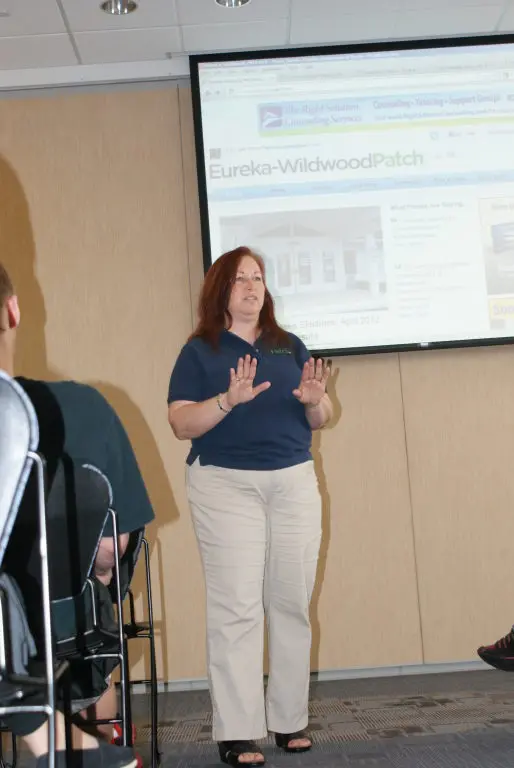
Students, faculty and staff of recently enjoyed a presentation by Eureka-Wildwood Patch editor, Julie Brown Patton.
Patton was invited to speak at , a noon series developed by Mark Weber, Art faculty member and Chair of Visual and Performing Arts at the STLCC-Wildwood Campus. Each semester, artists, musicians and writers are invited to the campus to showcase their work, and to discuss their creative skills and related careers. Patton was invited to speak, so she could provide students with an example of how writing skills are used in the working world.
The presentation began with the acknowledgement that undergraduate students often are unsure about which degree to pursue. Patton then led a dynamic discussion on how to develop a career path in journalism while utilizing writing, editing, marketing and graphic design. She noted that while she learned theories of journalism in school, the real world also provided lessons that are not covered in the classroom. Her most important piece of advice to her audience was: “…to be open to the unexpected.” She described how her original goal was to be a magazine editor, but when she attained that goal early in life, she began to look for other challenges. When she moved to St. Louis, she worked for a public relations/marketing firm and gained new experience by utilizing her knowledge of journalism and writing to help colleagues and clients of the firm.
Besides offering career advice to young writers and graphic designers, Julie Brown Patton demonstrated the attributes of being an active citizen. She discussed her role as editor of the Eureka-Wildwood Patch, and how adhering to an objective viewpoint on all topics was vital to providing the best information to the local community. In addition, she described the emerging interactive nature of news sites, and how community involvement with the Eureka-Wildwood Patch site provides individuals with a setting for civil discussions to occur.
As a writing instructor of freshman and sophomore students, I welcomed her information because part of our work at STLCC–Wildwood as General Education educators is to help students develop their communication, research, and thinking skills. Students learn subjects in the arts and humanities, and math and sciences. This is so they can develop their own informed perspective on important issues while understanding and respectfully responding to the perspective of others. Good communication skills paired with informed ideas are necessary for citizens of our democracy. The result is that we productively cooperate to identify problems and find solutions that benefit our communities.
Keeping children safe, whole and happy so they can realize their worth, and helping to develop good memories to sustain them, is the most essential work we can do to build our communities.
Christmas Morning 2012. I stood in the living room of a modest home, wearing a green Santa’s Elf hat; next to me was a man dressed as Santa. We were encircled by three little girls under the age of age 8 and a 10-year old boy. I helped Santa untie a large Hefty bag full of gifts. The children watched us, wide-eyed. It was my first Christmas as a volunteer elf for Santa’s Helpers Inc. in St. Louis.
Santa’s Helpers Inc. was founded by professor Rita Swiener in 1968. She explains that she heard about a family in need who had “fallen through the cracks” of social services during the December holiday season. Professor Swiener organized a collection of food and gifts for that family. Forty-four years later, she is still devoting tremendous energy to the cause of helping families in need during the holidays. She and others at Santa’s Helpers Inc. work all year round to prepare for that year’s holiday season. On Christmas Eve and Christmas Day of 2012, the organization’s volunteer Santas and elves visited over five hundred families in the St. Louis region.
I pulled the toys out of the bag one by one, and I helped Santa read the labels before he handed them to the kids. Santa’s Helper’s Inc. policy is that each child receives five items: an age appropriate book, toys and a Santa stocking. After Santa distributed several toys to the girls, it became clear that we did not have any toys for the boy. His face immediately fell. My heart was touched by his expression. I thought of my own children.
Santa told the boy that his gifts were in our other bag, and I went out to the car to get the Santa’s Extras bag. Several age-appropriate toys were inside. Years of experience have taught the organizers of Santa’s Helpers, Inc. that the Extras bag is a must. Sometimes, more children than originally reported are in the home. Social workers and social service agencies provide referrals of qualifying families with a list of names and ages of children; however, sometimes a child’s name and age is accidentally left off the list, or an additional child, such as a cousin or neighbor, is present in the home when a delivery is made.
When we gave the boy s collection of gift-wrapped toys, he smiled. As we prepared to leave, Santa stretched his arms out and boomed “Merry Christmas!” Hugs were exchanged all around, and we were on to the next stop. Santa placed addresses in Google Maps on his phone and gave directions, while I drove.
My impressions of the other visits are a blur. One home had no furniture. Another consisted of a sparse room with educational posters on the wall: counting to 10, telling the time, naming colors and shapes. At one stop, we met a family of seven in a small apartment: Dad, Mom and five young children. Every adult we encountered was caring and appreciative of our visit. Many adults and children gave us hugs. In one home, the children gave us handmade thank you cards and offered a plate of home made cookies to Santa.
During our visits, I thought of the children’s first days back at school in January, when each of them would be able to tell their friends they opened gifts this year. Being on an equal footing with peers can mean everything to a child. It might mean the difference between listening in class without being distracted or retreating within to nurse emotional hurts. A child’s worries may seem small to others, but to that child they are enormous obstacles to learning and to becoming a self-confident person.
As Professor Swiener says, at Santa’s Helpers Inc. “We never turn down help.” Throughout the year, beginning on December 27th, just after the successful deliveries of the current year, Professor Swiener and others begin work on plans for the following holiday season. This week, in fact, volunteers will clean the warehouse, continue to organize and wrap gifts, petition for funding from local donors, plan for fundraisers and to obtain new gifts to deliver during the next holiday season.
Students from St. Louis Community College have participated in service learning projects at the Santa’s Helpers Inc. warehouse during all seasons of the year. On Christmas Day, a high school teacher arrived with a group of students. He borrowed a Santa suit from a rack in the warehouse, gathered his deliveries and headed out with his students to make his rounds. Another man drove in from southern Illinois. He has been coming to help for the last few years. Last year, according to Professor Swiener, a group dedicated to Jewish-Muslim interfaith dialogue participated in a Day of Giving on Christmas Day and donned Santa suits to deliver the gifts. At any point in the year, Santa’s Helpers, Inc. welcomes inquiries from local groups who wish to perform a community service.
Professor Swiener, who is Jewish, is motivated to provide holiday gifts to needy children due to her own memories of being a child in an orphanage. She explains that during a holiday celebration, she was offered a selection of gifts but was told to just pick one. However, she wanted two gifts: a doll and a doctor’s kit. She was told to not be greedy and to only take one. Although she was later adopted by a loving family, the hurtful memory stayed with her. While she has good memories to sustain her, the memory of her time in the orphanage motivates her to make sure each child receives more than one meaningful gift when Santa visits his or her home.
Santa’s Helpers Inc. delivers to children of all faiths. Social service agencies refer families of all beliefs. Muslim and Jewish children may receive unwrapped gifts from conventionally-dressed visitors in recognition of religious mores.
There are some who decry the materialism of today’s holiday season and insist that children need to appreciate that they have food, warmth and shelter. However, organizations like Santa’s Helpers Inc. offer more than just material objects. The act of giving and receiving creates links within the community. A struggling family’s opportunity to participate in a societal tradition that is so significant to children enables all family members to have a sense of belonging. The gifts from Santa’s Helpers Inc. encourage a feeling of self-worth and self-definition in children. The goal is to create good memories that can outweigh the challenging ones that most human beings will experience. The smiles and the spontaneous hugs from the children we visited were enough for me to realize how deeply important that moment with Santa was for them.
The significance of our possessions evolves during our lives. In a study titled, “Treasured possessions and their meanings in adolescent males and females.” N. Laura Kamptner notes that while there is a traditional psychological view that treasured possessions in young children reflect a need for mother-comfort and emotional security, “treasured objects function in developmentally salient ways during adolescence by simultaneously mirroring the male and female adolescent self and (therefore) contributing toward the development of self-identity.” No matter the age, personal possessions fulfill emotional and practical needs. As children develop from infancy through adolescence, their possessions reflect and support a growing self-identity. That is why the gifts we delivered were age-appropriate for kids between the ages of birth through 12 years old.
I’ve always found it interesting that Professor Swiener’s story about her choice between the doll and the doctor’s kit reflects her essential self. As a former practicing psychologist who is now an adjunct professor of psychology at STLCC and at Maryville University, her early desire for a doctor’s kit indicated an interest in healing others. As a caring individual, parent and founding member of Santa’s Helpers, Inc., her youthful desire to have a doll reflected her nurturing nature. All children should have the chance to express their essential selves through play with age-appropriate toys.
I’ve occasionally given funds to, or volunteered with, Santa’s Helpers Inc., but this December was the first time I have volunteered on Christmas Day. I grew up celebrating Christmas and I know the fun of receiving Santa gifts. As a member of a family that observes Muslim and Christian traditions, I enjoy the sharing of many holiday moments. My own children practice Islam as their faith; however, we opened gifts on Christmas Eve morning and spent a wonderful day with plenty of food and treats. Spending time making Christmas morning deliveries to others, though, did not feel like charity. I felt that I was sharing; instead of only giving.
When we share with others in our community, we are meeting them on an equal plane in mutual respect. We are working to build our community together. The parents and grandparents I encountered during our visits were caring people who, although currently having a rough time, were trying to keep their children safe, whole and happy so they could realize their worth. That is the most essential work we can do to build our communities.
Like Professor Swiener’s experience, and like me during my own lived experiences, those I encountered are now going through a rough time but will find their footing by continuing to seek work, to study and live their lives.
The truth is, we all face challenges every day. Some challenges are economic; others are health-related or are due to a lack of a good education. None of us can judge what may have drastically impacted another person. What we can do is bring a little joy to someone’s’ life in order to create memories to feel good about. The good memories we foster in children can be sustaining. They will know that others care, and that they matter.
Simple moments, simple things. They can inspire us to realize our worth, develop our essential selves and pay forward to others in equal or greater measure.
St. Louis is experiencing the re-emergence of the periodic, 13-year cicada this spring. I noticed them this morning as I took my walk. I side-stepped them as I walked along dark, damp sidewalks in my neighborhood. The little, molting critters with the palest yellow, almost white, wings are cracking out of their brown cocoons almost in unison. Their dry, spent shells and newly hatched bodies cling to trees and car tires.
They are hatching fast, too. One cicada, who hatched on my car tire, was just poking a pale head out of its shell when I set out on my walk. When I returned 40 minutes later, ahead of approaching rain, it was already out and trying to dry its wings in the humid air. Once their wings and bodies dry, their colors change to dark green, black and brown with a webbed cloak of orange for wings. This is perfect camouflage for them as they sit and sing among leafy Missouri trees for the next few weeks.
In my home state of Texas, these insects are larger, and they appear every summer. We used to call them locusts, although a real locust is a relative of the grasshopper. As a child, this error used to confuse me. I grew up in a mostly secular home. We did not attend church or mosque, but I would read stories from the Bible and in my later teens, from the Quran. I would try to relate the singing cicada in our own trees to the swarming locusts mentioned in these holy books. They just did not swarm and plague in the same way in Texas, but now I know why. Cicadas are not locusts. And maybe insects aren’t always a plague but evidence of the miraculous cycle of life. However, farmers and termite-ridden homeowners might disagree with my idealism about bugs. In truth, I see their point. Insects often thrive on things we humans value: crops, wooden homes, and leafy shade trees.
Whatever their name or environmental impact, in Texas, I was aware of cicadas because of the hypnotic, buzzing, mating songs of male cicadas that would rise and fall in periodic waves all day long. While playing in the backyard wading pool, mowing lawns or just sitting on the front step watching the elm trees, the cicada song was ever present. I suppose this is the reason some Texans know them as Dog-day Cicadas. They do not appear every 13 or 17 years; instead, while groups of them may have a 13- or 17-year cycle, they are always there singing their mating song, happily buzzing their lives away in the Texas heat. There are websites devoted to the East Texas Cicada, or Dog-day Cicada. Texas A&M devotes a page about the Dog-day Cicada on its Field Guide website.
Kids in my old neighborhood used to catch these large, flying cicadas, tie strings around them and fly them like kites. This practice usually did not end well for the bug, which more often than not would crash into a sidewalk or wall in its attempt to get away. As a little girl, I tried to put a stop to this practice by appealing to my friends’ sympathy for the bugs; however, cicadas were not a favorite of mine. If I startled one as I ran past a tree, it would fly into me. Sometimes one would get tangled in my hair, causing me to shriek and bat it away.
I think of all of this as I walk along my damp, Missouri sidewalk: cicadas and locusts, life-songs made from wings, the periodic waves of birth and rebirth so ancient that they are noted in our holy books. The 13-year cicada has emerged to sing in our part of Missouri for the next few weeks. Their cracking cocoons and little, crackling dry shells are pieces of the divine; scattershot across sidewalks, trees, cars and walls.
Moms Talk: Are we serving ALL students well by dividing student populations, based on definitions of giftedness and on test scores intended to identify gifted children?
Many K-12 education programs are under review, due to budget concerns, and I’m curious to see how gifted education will be impacted in our local school districts.
Because change may be coming, now is the time to ask if we are serving all students well by dividing student populations based on current definitions of “giftedness” and on test scores intended to identify gifted children.
My oldest son will enter sixth grade this year, so my first-hand experience with gifted education is mainly with kindergarten through fifth grade. My son was nominated to be tested for our district’s gifted program by his kindergarten teacher. I was surprised, but intrigued, as I had not given much attention to the idea of gifted education before. When my son was tested and identified as a gifted learner, I was glad for him, but I felt hesitant to fully embrace the program. This is because I knew of other kids who were very bright, focused, and curious learners but who had not been offered a chance to be tested. Or, they had been tested but deemed “not gifted.”
I felt uncomfortable with the idea that kindergarteners could be identified as gifted because that seemed to infer there are those who are “not gifted.” This did not seem right to me.
As the years passed, I formed certain impressions of gifted education. The first and most important was that my son benefited from the experience. He enjoyed the learning opportunities assigned to him. He said the difference between work in regular school and at the gifted center was that he could actively work on questions in the gifted program. He learned by doing more frequently, and often as part of a group project. He applied research to real world problems and interacted with representatives of local industries. This was in contrast to listening to lectures and working on projects individually at his home school.
However, there was also a downside. He had to ride the bus to a different school once a week to participate in the program. This took him away from friends who were not in the program, which affected him socially. He also did not care for the 30-minute bus ride to and from the other school. There also was some talk of the “smart” kids being taken away from school once a week. To the kids left behind, this seemed like the gifted kids were being rewarded, which sometimes resulted in resentment toward my son.
Parents of kids who were not in the program occasionally spoke of the challenges of assuring their children that they were also smart. Because I have another bright child who is not in the gifted program, this is an issue I dealt with at home as well.
The disruption of classroom communities and the exacerbation of sibling rivalries leads me to wonder if we are serving all students well by separating a group of students to create an elite, “gifted” population. Perhaps it would be better to create learning opportunities for high performing students at their home schools.
Ultimately, we most appreciate community members who have emotional intelligence and good social skills, along with other forms of intelligence and creativity. If nothing else, renaming the program as something other than “gifted” could be a good start toward creating an integrated learning community that benefits more students.
What do you think is the best way to make sure all students benefit from active learning opportunities?
Editor’s Note: Layla Azmi Goushey is a member of our Eureka-Wildwood Moms’ Council, which is a group of parents who volunteer as community leaders and who will lead us through important, online discussions. Moms’ Council members are serving to help shape and influence our Patch content to assist busy parents.
Layla Azmi Goushey teaches English at the Wildwood campus of St. Louis Community College. She has a master’s degree in fine art in creative writing from the University of Missouri – St. Louis (UMSL). She is a doctoral student in Adult Education/Educational Leadership and Policy Studies at UMSL. Some of her areas of interest are adult literacy and technology-based critical literacy, Arab-American literature and the Harry Potter series. She teaches an online interdisciplinary studies course based on the Harry Potter series at St. Louis Community College-Wildwood.





 Layla Azmi Goushey